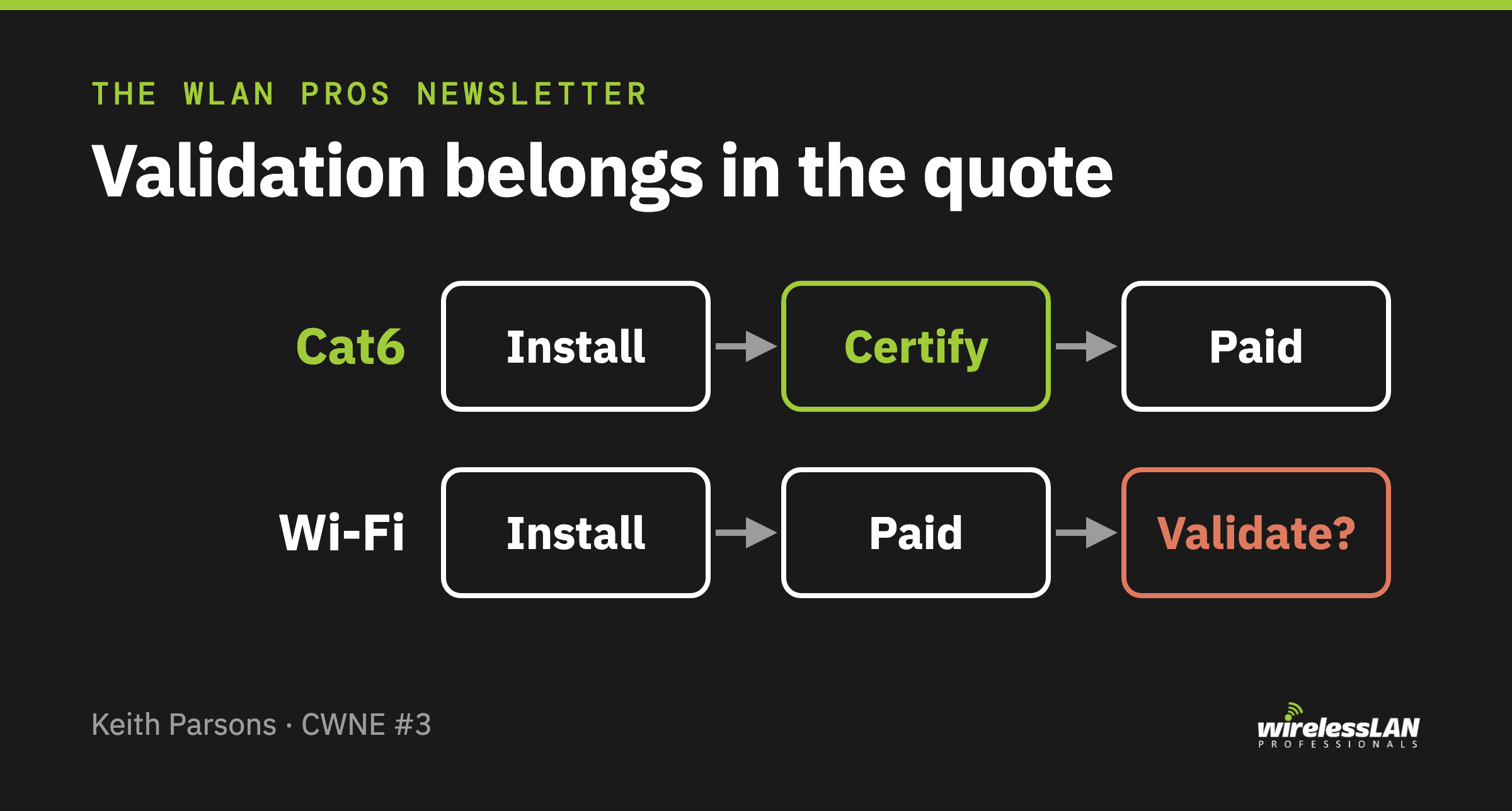
When do you validate Cat6 cable? After it's installed. So when should you validate Wi-Fi? After it's installed.
I've been asking that question in my public presentations since at least 2018, and I've been beating this drum for over 25 years. It came up again at the end of September on the Wi-Fi NOW Design, Validation and Test Forum, and it deserves more room than that short response gives it.
How cable gets accepted
A cabling contractor finishes pulling Cat6 through a building. Before anyone calls the job done, every link gets tested against a published standard, on a tester that is itself held to a published accuracy level.
The standards are boring, and that's the point. ANSI/TIA-568.2-D defines what a passing link looks like. ANSI/TIA-1152-A defines which field tests are required and how accurate the tester has to be. The ISO and IEC side has its own equivalents.
Then the paperwork makes it stick:
-
The owner won't accept the job without the results. One public example, the City of Houston's cabling spec, says it plainly: "No cabling installation is considered complete until test results have been completed, submitted and approved." And it wants 100% PASS.
-
The manufacturer won't stand behind the system without them. The long system warranties from the cabling makers, 15 to 25 years and some longer, require the installer to submit passing test results.
-
Only a certification test counts. A tester that tells you "the wires are connected" is a different class of tool from one that measures the link against the standard. The warranties want the second one.
So the cabling contractor doesn't get paid until the cable is proven. Nobody thinks that's unreasonable. Nobody asks for a discount to skip it.
How Wi-Fi gets accepted
Mostly, it doesn't.
The practice is written down. ANSI/BICSI 008 includes a validation survey in its design and deployment cycle. CWNP's design certification gives validating and optimizing the WLAN a quarter of the CWDP exam. Every design tool on the market can do a validation survey.
What wireless never got is some mechanism to enforce the validation requirements. There's no warranty that depends on a survey, and no standard acceptance step that says the network isn't finished until it's measured.
Instead, somewhere along the way, salespeople started selling validation as an add-on. "Oh, you want us to come back and validate our own work? We'll charge you for that." So many customers never did the validation part. They turned on their Wi-Fi, and they never had any knowledge of whether or not the totally INVISIBLE Wi-Fi network met any requirements at all. That's the part that bothers me. Not that doing a validation survey costs money. That the customer was handed a network and nobody, including the people who designed it, could tell them whether it met the requirements they asked for.
Why it isn't optional
A predictive design is math. Good math, and the tools have become amazing at it. But it's math built on what we put in: the wall types, the attenuation values, the mounting heights, the antenna patterns the AP maker supplied.
Then you go on site, and the building is the building. A wall isn't where the floor plan says. Ceiling heights may or may not match the floor plans. I've watched one access point cover only 20 meters, swapped in another of the same make, same model, and had 30 meters at the matching signal levels.
The only way to know what you actually built is to measure it. That's what the validation survey is: the measurement that tells you whether the wireless network meets the requirements you were given.
What I do
I don't give a quote for a design without a validation survey in it. It's in the price from the first conversation, not offered as an option on the last page.
For a big event this year, that meant walking the entire floor every four or five meters in a grid, at least twice a day, plus roaming tests with a laptop and a phone several times a day. Most jobs don't need that pace. But EVERY job needs a validation survey!
If you write it into your own quotes, a few things make it hold:
-
Make it a line item, not an option. If it's optional, someone will cut it to make the number smaller.
-
Say what it's measured against. The survey validates the requirements, so the requirements have to be written down first. That's why I spend the majority of my design time on getting requirements dialed in.
-
Say what the customer gets. A validation report at handoff, and a design file updated to match what was measured. And as a side note, the customer OWNS the validation survey data. It is theirs to keep, share, or have others review.
-
Put it on the schedule. After install, before handoff, with enough time to fix what it finds.
Some owners already write it in themselves. The University of Washington, for one, publishes a requirements guide for post-installation Wi-Fi surveys on its larger building projects. If owners can require it, we can offer it without being asked.
The part that makes you better
There's one more reason, and it's selfish. Every validation survey tells you where your design was wrong. If you go back and fix the design file to match what you measured, you learn something on every job. More on that next week.
Is validation in every Wi-Fi quote you write, or does it still show up as an extra?
Sources
Cabling: ANSI/TIA-568.2-D; ANSI/TIA-1152-A; IEC 61935-1; City of Houston Section 271500 (v5.0, 2025), 3.11; CommScope 25-year System Warranty; Panduit Certification Plus and PN654. Wireless: ANSI/BICSI 008; CWDP-305 objectives (2024); University of Washington, Requirements Guide for Post-Installation Survey.